As part of our ongoing mission to advance serious, evidence-based discussion around Unidentified Anomalous Phenomena (UAP), the Disclosure Foundation continues to engage directly with leading academic institutions.
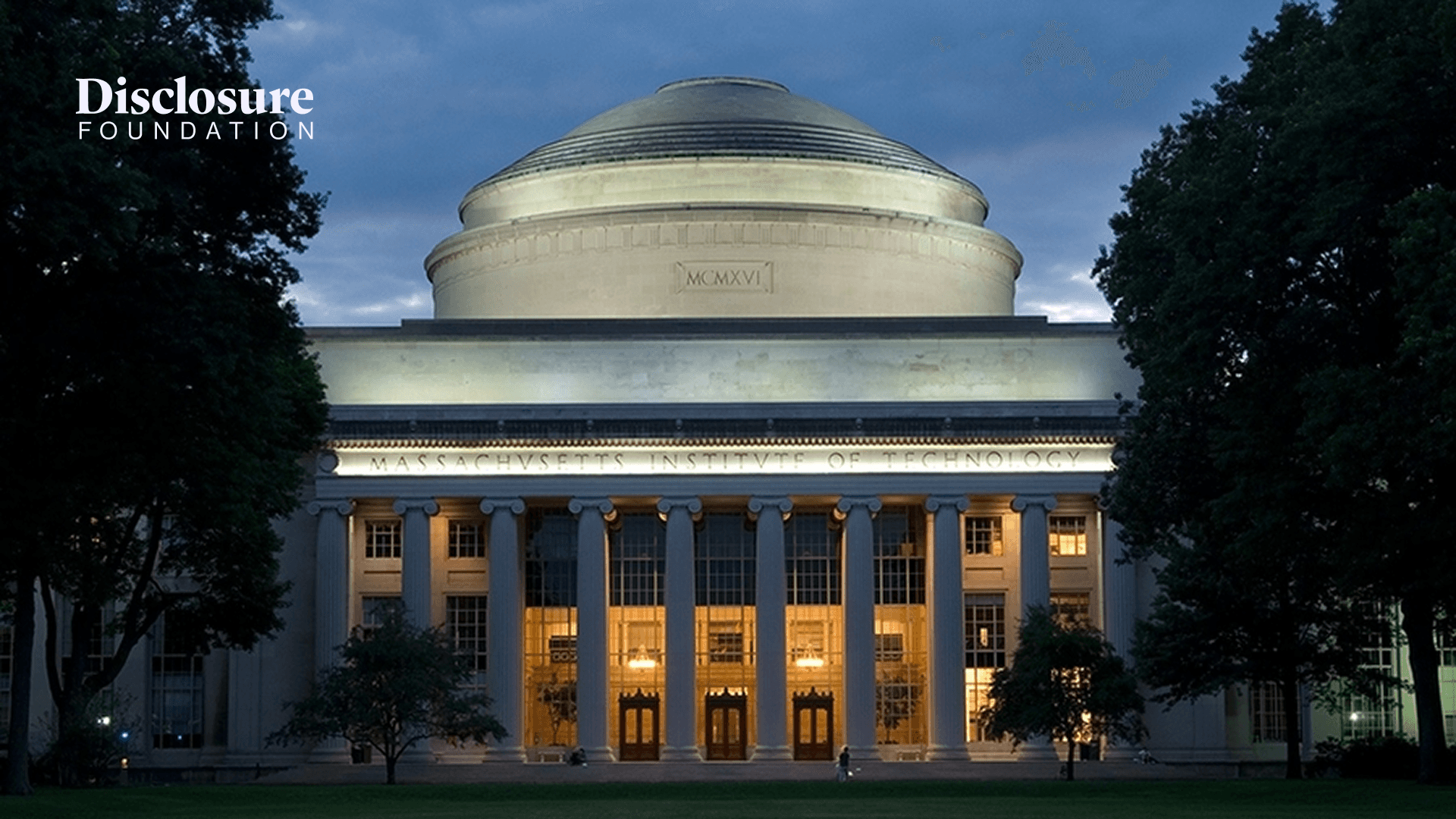
Last week, our Executive Director served as a keynote speaker at Massachusetts Institute of Technology for Confronting Unknowns, a course led by Jonathan B. Miller that examines how institutions, markets, and societies respond to uncertainty and incomplete information.
The discussion explored UAP not only as a scientific question, but as an issue with real implications across public policy, national security, innovation, and risk governance. The course brought together a multidisciplinary group of students and professionals willing to grapple with ambiguity in a rigorous, solutions-oriented way, an environment well-suited to a topic that sits at the intersection of science, government, and public trust.
This engagement at MIT builds on prior in-person conversations hosted at Princeton University and Yale University, where we have worked to expand serious, non-sensational discourse on UAP within leading research institutions. Across these settings, our focus has been consistent: to treat uncertainty not as something to avoid, but as a condition that institutions must learn to navigate responsibly.
We believe higher education plays a critical role in preparing future leaders to confront complex and unresolved questions with intellectual rigor and humility. Engaging universities is a core component of our broader strategy to build long-term understanding, institutional readiness, and informed public dialogue around UAP-related issues.
Academic environments provide space for careful inquiry, cross-disciplinary thinking, and the development of frameworks that can later inform policy, governance, and public communication. As interest in UAP continues to grow across scientific, governmental, and private-sector communities, we view these engagements as an essential part of building durable, responsible pathways forward.
We are grateful for the opportunity to contribute to these conversations and look forward to continuing this work with academic partners in the future.