
News
Advisory Board Member Avi Loeb to Lead New UAP Science Advisory Council
June 14, 2026
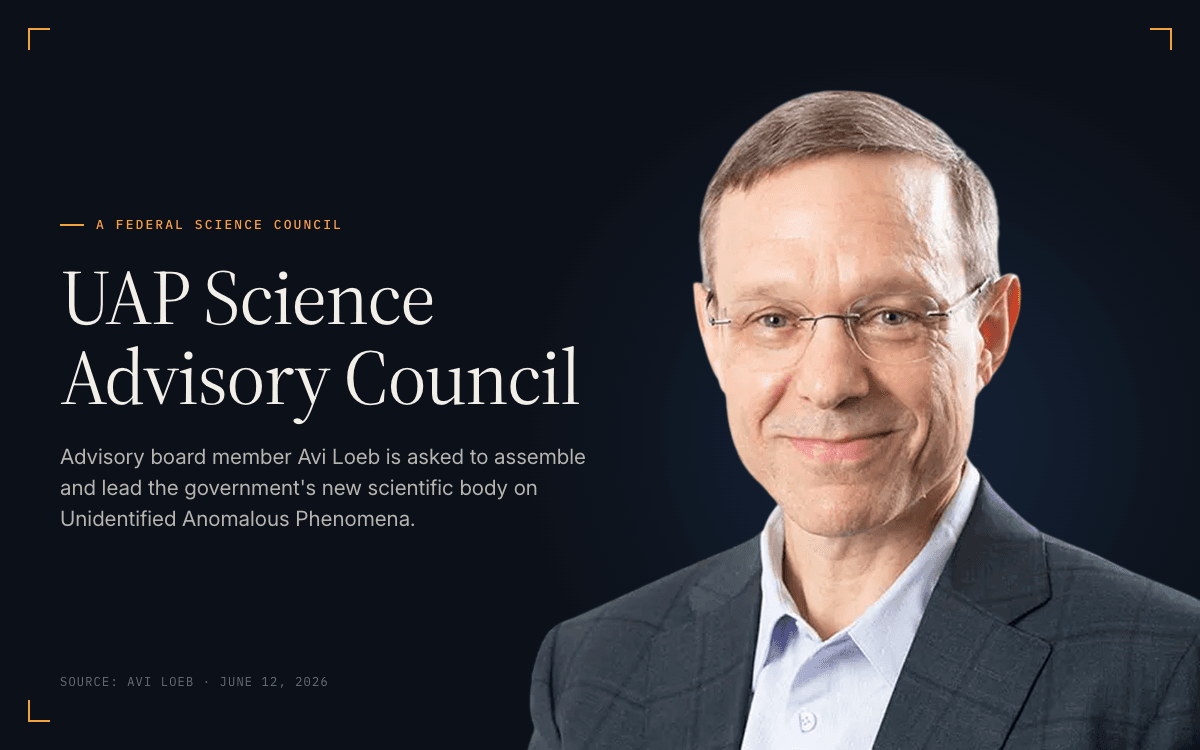
Harvard astrophysicist Avi Loeb, a Disclosure Foundation advisory board member, writes that he has been asked to assemble and lead a UAP Science Advisory Council to support U.S. government agencies with rigorous scientific analysis.
This report is based on public announcements by Prof. Avi Loeb, a member of the Disclosure Foundation's advisory board. The tasking and council membership described below reflect his own account.
Prof. Avi Loeb, the Harvard astrophysicist who leads the Galileo Project and serves on the Disclosure Foundation's advisory board, has announced that he was asked to assemble and lead a new UAP Science Advisory Council to support the federal government's work on Unidentified Anomalous Phenomena.
Writing on the same day the government released its third batch of declassified UAP files, Loeb said the council was established by the White House, the All-Domain Anomaly Resolution Office (AARO), the Office of the Director of National Intelligence (ODNI), the Federal Bureau of Investigation, and other members of the Intelligence Community. He described being tasked over the prior week with building a team of scientists to serve on it.
The council
Loeb will chair the council, which he describes as "an amazing A-team of exceptional scientists and experts." Its members span disciplines from data science and instrumentation to biology, oceanography, anthropology, and psychology:
- Prof. Carol Cleland, anomaly identification
- Dr. Richard Cloete, data analysis and AI tools
- Dr. Omer Eldadi, data management, AI, and human psychology
- Dr. Tim Gallaudet, oceanography
- Ross Howard, communication
- Dr. Devesh Nandal, numerical analysis and astrophysics
- Prof. Garry Nolan, molecular biology and materials science
- Dr. Regina Sarmiento, data analysis and AI-assisted data management
- Dr. Michael Shermer, the study of anomalies
- Prof. Peter Skafish, anthropology
- Prof. Matthew Szydagis, instrumentation and data collection
- Dr. Jennice Vilhauer, quantitative psychology
Loeb and Rear Adm. Tim Gallaudet, U.S. Navy (ret.), the oceanographer and former acting NOAA Administrator, both serve on the Disclosure Foundation's advisory board.
The group's stated purpose is to help government agencies study the nature of UAP through rigorous scientific methods, with an emphasis on collecting and analyzing higher-quality data rather than relitigating older material that cannot be independently verified.
Why now
The announcement arrived alongside the third release of government UAP files. Among the newly public documents is a report dated June 5, 2026 and signed by Dr. Jon Kosloski, the director of AARO, describing anomalous phenomena observed by law enforcement officials over two days in October 2023, including an orange "mother" orb that appeared to launch smaller red orbs. According to that report, roughly 40 percent of the phenomena documented in the case remain unexplained.
For Loeb, that unresolved fraction is precisely where scientific attention belongs. He has consistently framed the question around two possibilities, both of which he argues deserve serious study. The first, and most down-to-earth, is that some objects are human-made technologies operated by other nations, in which case their appearance near sensitive sites would represent a national security concern. The second, which he describes as far less likely but far more consequential, is that a small number of objects could have a non-human origin. Distinguishing between the two, he argues, calls for better instruments and careful analysis rather than speculation.
A scientific footing for disclosure
The Disclosure Foundation has long held that releasing records is a necessary first step but not the destination. The harder work is rigorous, independent analysis: better sensors, transparent methods, and a chain of custody that lets the public verify findings rather than take them on faith. A standing scientific council positioned to advise government agencies reflects that same priority, and we welcome any effort that puts the question of UAP on a firmer scientific footing.
Prof. Loeb will join the science panel at the Disclosure Forum in Washington, D.C. on June 25, 2026, where the path toward rigorous UAP science, this new council among the topics, will be a central part of the conversation.
"Identifying the unidentified deserves a high priority within the U.S. government and the scientific community," Loeb wrote.