
News
Pennsylvania House Holds Hearing on UAP Reporting and Scientific Inquiry
July 1, 2026
The Pennsylvania House Communications and Technology Committee held an informational meeting on unidentified anomalous phenomena, featuring testimony from Christopher Mellon, Ryan Graves, and Penn State astrophysicist Jason Wright.

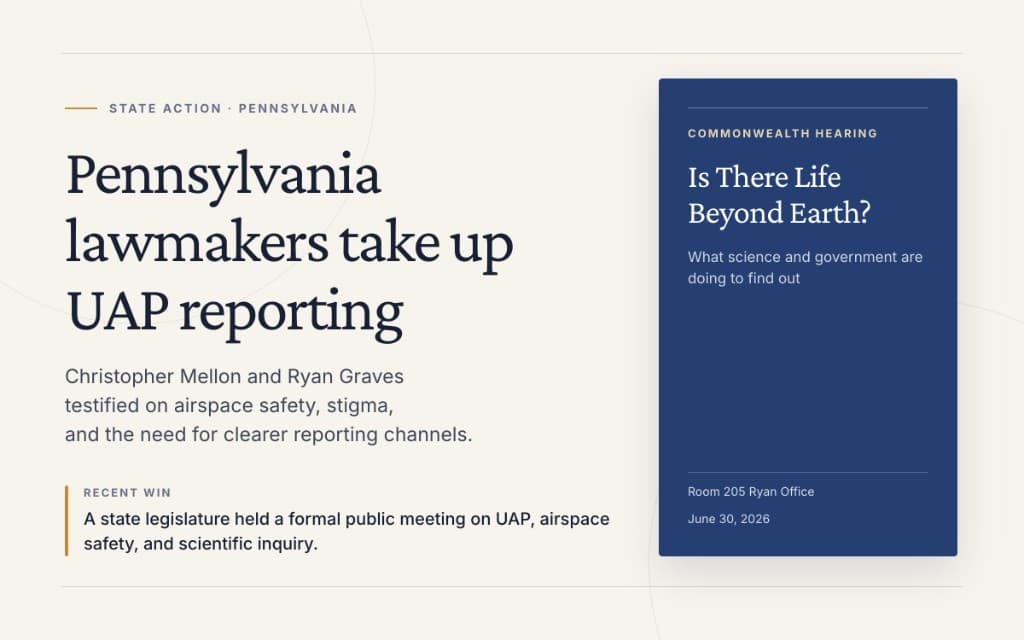
On June 30, 2026, the Pennsylvania House Communications and Technology Committee held an informational meeting on identifying and understanding anomalous objects and signals. The hearing was formally titled “Is There Life Beyond Earth? What Science and Government Are Doing to Find Out.” The meeting placed unidentified anomalous phenomena, airspace safety, and the scientific search for technosignatures inside a state legislative setting.
The hearing was requested by state Rep. Ben Waxman and covered by PennLive, which reported that the session examined gaps in reporting channels across Pennsylvania. Witnesses included Christopher Mellon, Ryan Graves, and Penn State astrophysicist Jason Wright.
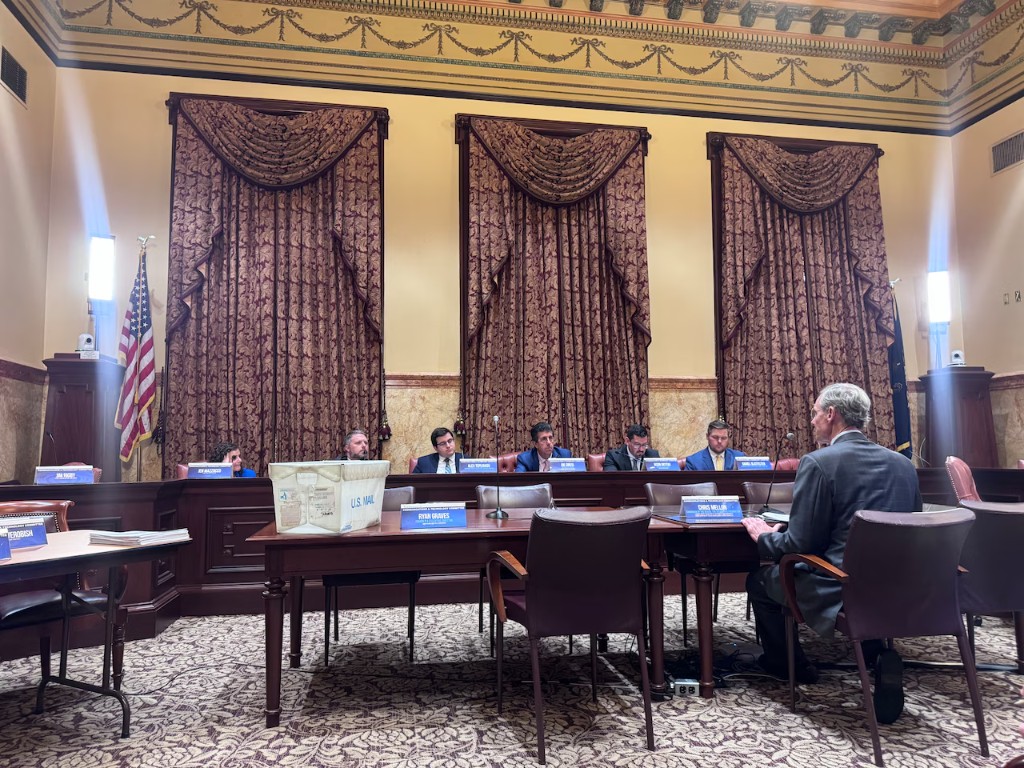
Christopher Mellon testifies before the Pennsylvania House Communications and Technology Committee during its June 30 informational meeting on UAP reporting, airspace safety, and scientific inquiry. Photo: DaniRae Renno / PennLive.
Mellon, chairman of the Disclosure Foundation board and a former Deputy Assistant Secretary of Defense for Intelligence, testified about reports of unidentified aircraft entering restricted military airspace and the institutional stigma that has limited serious government response. “Our government was frankly paralyzed by a social phenomenon called stigma. And that was and is more effective than any technical system I’ve ever seen,” Mellon said, according to PennLive.
Graves, a former Navy pilot and founder of Americans for Safe Aerospace, focused on aviation safety and reporting systems. PennLive reported that Graves recommended support for state and local law enforcement to collect reports, dedicated reporting mechanisms for critical infrastructure, and clearer communication with local communities.
Wright, a professor of astronomy and astrophysics at Penn State and director of the Penn State Extraterrestrial Intelligence Center, framed the discussion through the scientific search for technosignatures. His testimony connected the hearing to Pennsylvania’s own scientific institutions and the next generation of research talent.
The hearing is another sign that serious UAP policy work is no longer confined to Washington. State lawmakers are beginning to ask how public safety, critical infrastructure, aviation reporting, and scientific inquiry should fit together when unusual objects or signals are reported.