
News
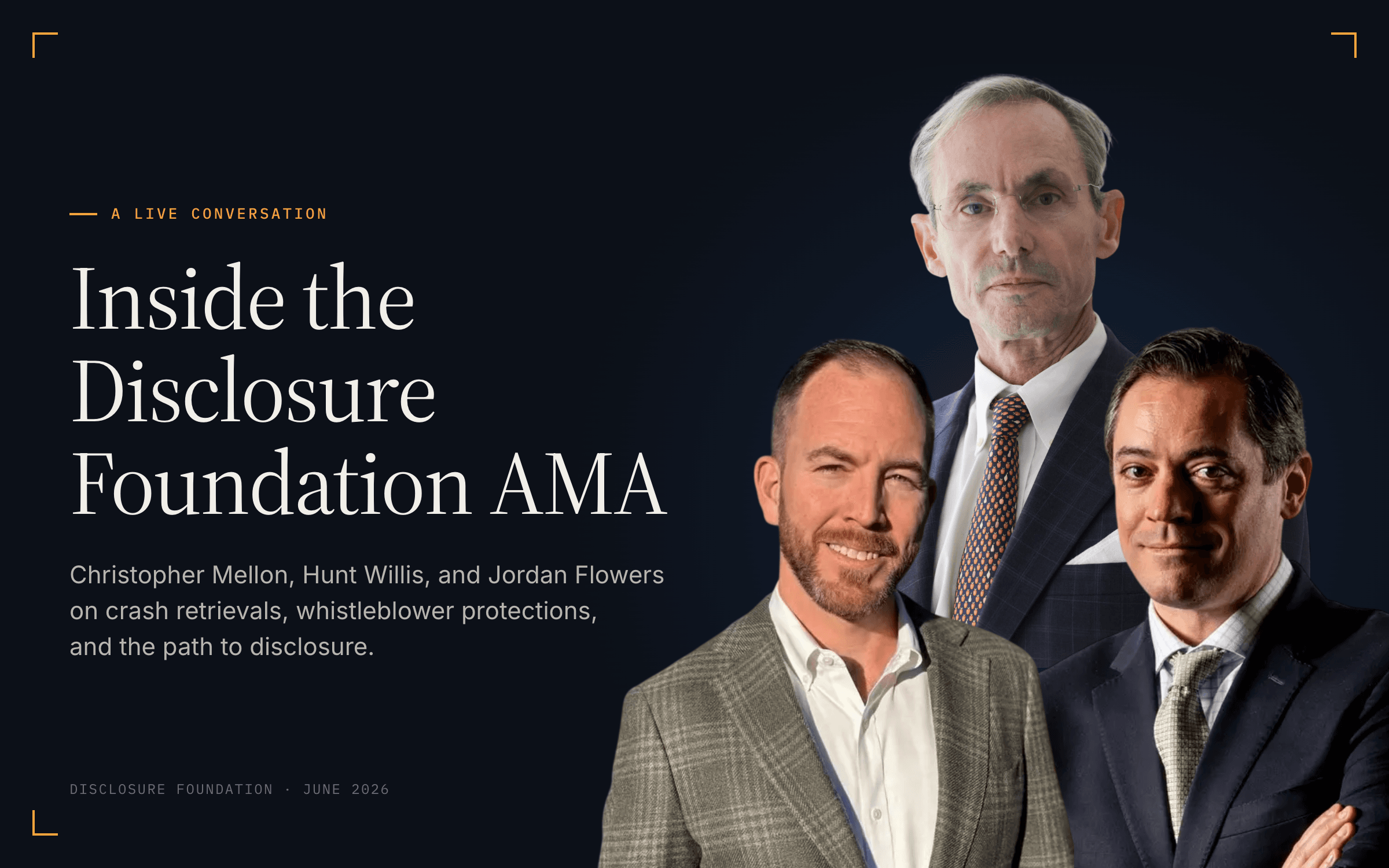
Inside the Disclosure Foundation AMA: Crash Retrievals, Whistleblowers, and the Path to Disclosure
June 17, 2026
In a recent Ask Me Anything, Chris Mellon, Chief Legal Officer Hunt Willis, and Executive Director Jordan Flowers took audience questions on crash retrieval reporting, recovered craft, congressional oversight, whistleblower protections, and why the public case for UAP began with national security.
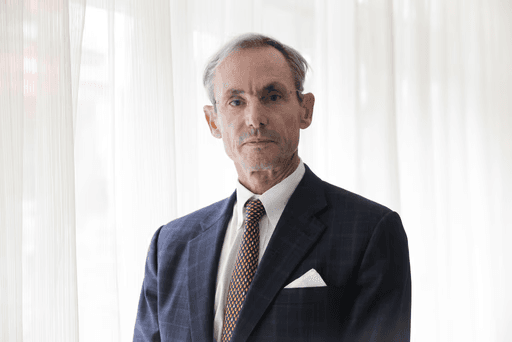
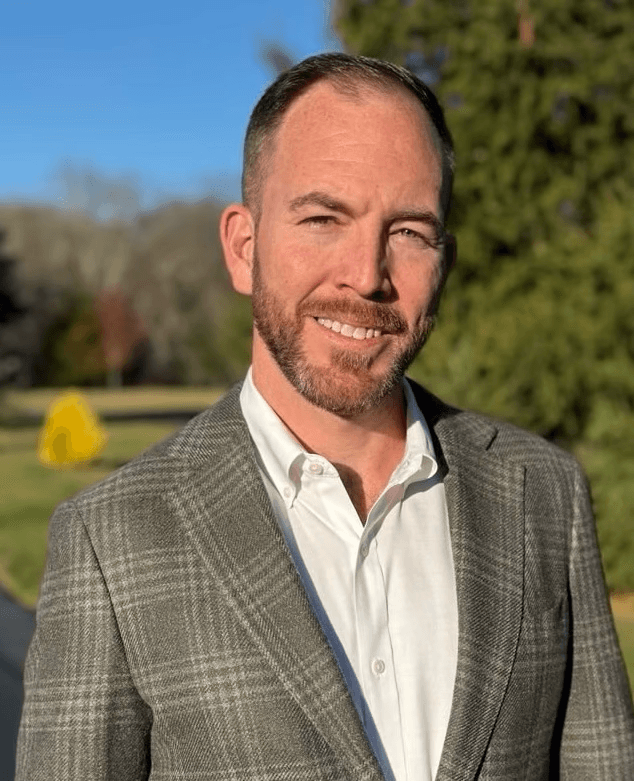
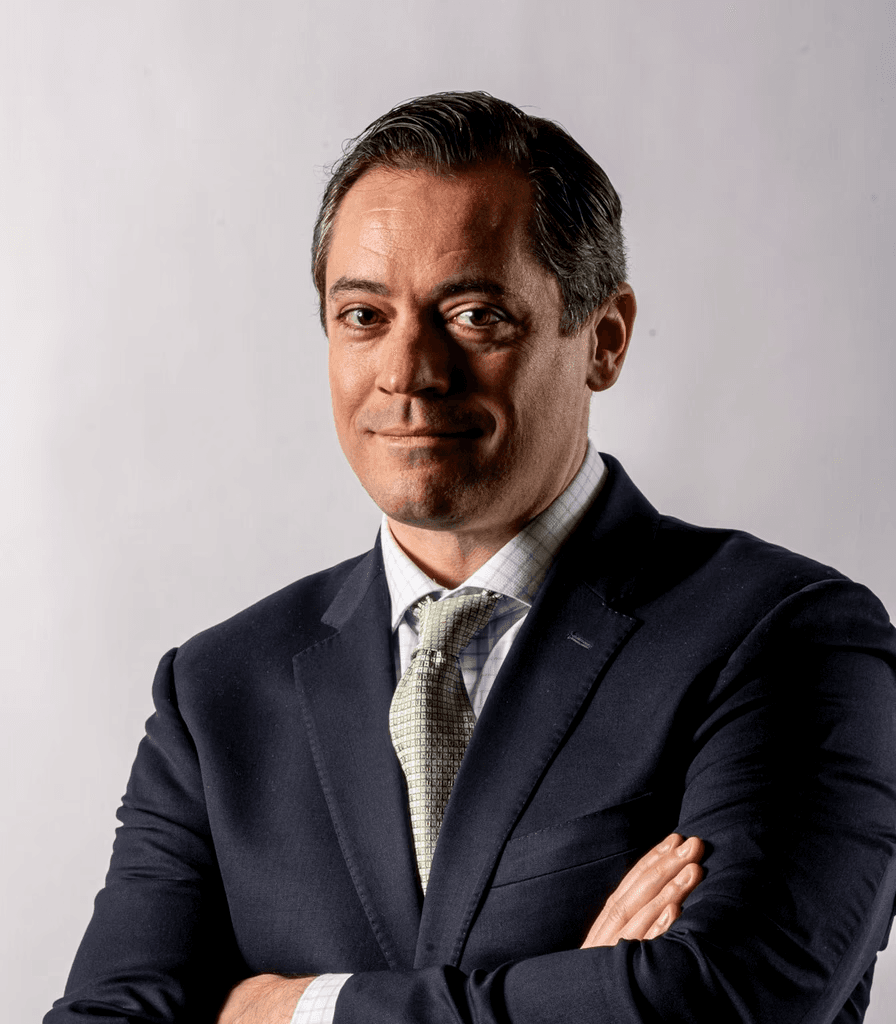
This post collects clips from a recent Disclosure Forum Ask Me Anything session conducted on Sunday, June 14. Claims attributed to sources are presented as their assessments, not as established fact.
The Disclosure Foundation recently held a live Ask Me Anything session with Christopher Mellon, Executive Director Jordan Flowers, and Chief Legal Officer Hunt Willis, moderated by journalist Leslie Kean.
The conversation addressed many of the questions now at the center of the public UAP debate: how to address crash retrieval reporting, why firsthand witnesses have been difficult to bring forward, how Congress can compel answers, what legal protections exist for whistleblowers, and why the public case for UAP began with national security and flight safety.
There are at least two tracks in the current disclosure effort. One involves records, sensor data, satellite imagery, radar tracks, and other government-held information that may be identified, reviewed, and released. The other involves claims that require direct testimony, documentary evidence, the production and examination of physical materials, and congressional oversight, including allegations of crash retrievals, recovered craft, biological evidence, special access programs, gatekeepers, private contractors, and witnesses with direct knowledge.
The ultimate goal remains disclosure, lawful oversight, and accountability for any appropriate physical materials. Based on David Grusch's recent public comments, including his account that he has seen photographic images of recovered craft, if photographs of the kind he described are released through PURSUE or another official channel, that would dramatically increase demand for Congress and the executive branch to pursue this line of inquiry. This possibility is part of why the Foundation is working to build pressure and momentum now by identifying and releasing compelling, less sensitive records and data. Work on both tracks is now moving in parallel. Releasing records and sensor data is not a substitute for investigating crash retrieval claims. Congress, whistleblowers, attorneys, journalists, and oversight bodies are working to determine what information exists, where it resides, and how it can be accessed and evaluated. That challenge extends beyond government agencies, as many crash retrieval allegations involve claims that recovered materials or related records may be held by private contractors or other non-government entities. Understanding the pathways to obtaining information from both inside and outside government is therefore essential to meaningful disclosure on the UAP issue.
The Foundation is active on both tracks, not only the first. On the records track, its legal team uses formal tools to force material into the open: a Freedom of Information Act appeal recently compelled the National Security Agency to release hundreds of pages of formerly Top Secret UMBRA UAP records. On the harder track, which turns on crash retrievals, recovered craft, and biological evidence, the Foundation has worked to connect those claims with the people empowered to investigate them. As described in the clips below, Mellon provided the name of an alleged Air Force "gatekeeper" to congressional oversight committees and to AARO, and the Foundation has encouraged firsthand sources, including the individual behind the 2022 Signal message, to come forward to Congress as witnesses. This is most apparent in a 2023 Politico article written by Mellon entitled “If the Government Has UFO Crash Materials, It’s Time to Reveal Them” wherein he advocates for the disclosure of such materials.
It has also supported congressional oversight more directly: by “facilitating access” to information described as UAP "legacy" program code names and the names of senior officials believed to have had direct access to those programs, and by delivering to Members notes authored by Dr. Eric Davis, an advisory board member whose work on these matters is already public. And it has published a legal policy brief detailing how lawmakers can lawfully receive classified UAP information and how those who hold it can provide it through lawful channels.
This is no longer an effort driven by Congress alone. In recent months the executive branch has taken a leading role, with the White House directing the release of UAP records and data across multiple agencies. The executive branch holds most of the relevant material, but it is not a single, unified actor. Even as the White House presses for disclosure, other parts of the executive branch, including within the intelligence community and the armed forces, have been more resistant to releasing what they hold. Meaningful progress depends both on whether executive leadership can overcome that internal resistance and on Congress continuing to exercise its own oversight authority.
The clips below capture several of the most substantive moments from the AMA.
Featured: Christopher Mellon, Chairman of the Board; Hunt Willis, Chief Legal Officer; and Jordan Flowers, Executive Director, in conversation with Leslie Kean, who helped break the 2017 New York Times story on the Pentagon's UAP program.
On Crash Retrievals, Recovered Craft, and Possible Recovered Beings
For newcomers, "crash retrieval" refers to the long-circulating allegation that the U.S. government has recovered craft of unknown or non-human origin, and in some accounts non-human biological material, and studied them outside public view.
In 2023, former intelligence officer David Grusch testified to Congress, under oath, that he was informed of a multi-decade UAP crash retrieval and reverse engineering program through interviews he conducted as part of his official duties. More recently, Grusch has said publicly that he has seen photographs of recovered vehicles.
In this clip, Christopher Mellon discusses a 2022 Signal message in which a source described a possible recovery program structure and oversight apparatus. Mellon explains why he found the account credible, how it relates to Grusch's more recent statements, and why getting firsthand witnesses to repeat such claims in front of Congress has proven difficult.
A note on this clip. Chris Mellon references Dr. James Lacatski, the Defense Intelligence Agency officer who directed the Advanced Aerospace Weapon System Applications Program, known as AAWSAP. At the time this question was asked, Mellon was not aware that Dr. Lacatski had been facing a serious health matter. This news reached the team during the live session, and Mellon acknowledged it later in the AMA, though not in this clip. We are keeping Jim in our thoughts and wish him a full recovery.
Not a Single Source
A recurring question about UAP testimony is whether it rests on a single anonymous tip or one unverified account. In this clip, Mellon makes clear that the 2022 Signal message was not his only lead. He made the same point on the record in a June 2023 Politico op-ed, where he wrote that multiple well-placed current and former officials had described the alleged recovery and reverse engineering program to him.
He describes other insiders he considers credible, including one who believed he had worked with material of non-human origin. At the same time, Mellon emphasizes the evidentiary standard that must guide this issue: secondhand information is important, but it is not enough. The goal is definitive information, firsthand testimony, records, and the production of physical materials that can withstand scrutiny.
Mellon is equally candid about the limits of his own position. He has no firsthand knowledge of any recovery program, and no ability or opportunity to independently verify or confirm what these sources have described to him. He treats their accounts as serious leads to be tested, not as facts he can personally vouch for.
That is the balance the Foundation believes this subject requires: take credible witnesses seriously, but continue pressing for evidence that can be evaluated independently.
The Air Force "Gatekeeper" and Why Congress Has Not Forced the Issue
A recurring allegation in this field is that a small number of officials act as "gatekeepers," controlling access to the most sensitive UAP information and material and keeping it from congressional oversight, executive oversight, and the general public.
In this clip, Mellon recounts giving the name of an alleged Air Force gatekeeper to congressional oversight committees and to AARO, the All-domain Anomaly Resolution Office, years ago.
He also explains why this kind of follow-up is difficult in practice. A witness who does not want to cooperate may need to be compelled. Congressional subpoenas are serious tools, but they are not issued casually. Documents and names can also stall inside congressional staff channels if they are not elevated, circulated, or pursued consistently.
This is one reason the Foundation continues to emphasize process. Public pressure matters, but so do oversight mechanics: who receives the information, who follows up, who has subpoena authority, who is willing to use it, and how protected witnesses can safely come forward.
Why the National Security Case Came First
For years, the public UAP case was framed primarily around national security, airspace safety, pilot reporting, military encounters, and sensor data. That framing has left broader questions involving recovered craft, non-human intelligence, consciousness, history, religion, philosophy, and human experience.
In this clip, Jordan Flowers explains that the Foundation is working to widen the conversation beyond technology and defense, including through the June 25 forum in Washington, D.C., which includes panels on national security, science, technology, religion, philosophy, psychology, and culture.
Mellon then explains why the national security frame came first. At a time when the subject was still treated as unserious, it was the only viable way to get traction with Congress and force the Department of Defense to address data it did not want to release.
That strategy was never meant to exclude the other dimensions of the phenomenon. National security was the entry point, not the destination. It is what made the current public conversation possible, and it is what now allows that conversation to widen toward the scientific, historical, and human questions the subject ultimately raises.
Lawful Disclosure, Whistleblower Protections, and Amnesty
People who have direct knowledge of UAP programs often face a difficult choice. In some cases they believe that Congress and the public have a right to know, but they also fear prosecution, loss of clearance, professional retaliation, and financial harm.
In this clip, Mellon, Willis, and Flowers discuss the lawful channels available for individuals who want to provide classified information to Congress. They distinguish between public disclosure of classified information, which can carry serious legal risk, and appropriately providing information to members or committees of Congress through lawful channels.
Willis also addresses the practical reality that legal rights do not eliminate all risk. Administrative retaliation, clearance issues, career consequences, and contractor-specific concerns can still arise. Chris Mellon speaks to his own experience with that kind of retaliation, while noting that he has not faced legal consequences. That is why the Foundation encourages anyone with relevant information to speak with legal counsel they are comfortable with, about their specific situation, before taking action. As Willis emphasizes, every individual's case is different, and the right path is the one that works for that person, not a route toward any single organization.
The conversation also touches on amnesty. The Foundation's view is that this issue requires precision. There may be a case for protecting individuals whose only offense was participating in secrecy or making unauthorized disclosures in service of truth and oversight. That does not mean a blank check for serious crimes, violence, or abuse.
If you have direct, credible knowledge of UAP programs and are weighing how to come forward, every situation is different, and the first step is to work with legal counsel you trust. There is no single destination, and the right path is the one that fits your circumstances. The Foundation can help directly: its legal team offers confidential, no-cost guidance to prospective witnesses and whistleblowers thinking through their lawful options, including how to bring credible claims to Congress through proper channels.
Where This Goes Next
The Foundation's position is straightforward: releasing records is a necessary step, not the final destination.
Both Congress and the executive branch have a role to play. Congress holds the tools of sustained oversight: subpoenas, whistleblower protections, and the authority to compel testimony and preserve documents. The executive branch, and the White House in particular, holds the broadest discretion to act, with the authority to direct declassification across agencies and to move quickly on the questions the public cares about most, including crash retrieval allegations, recovered materials, and the firsthand accounts behind them.
That discretion is an opportunity. Used fully, it could resolve questions that have lingered for decades.